Can AI Trade for You? I Checked the Evidence
New AI models make it look easy to hand a bot your brokerage account. I checked the research, the speed math, the costs and the rules. Here's what holds up.
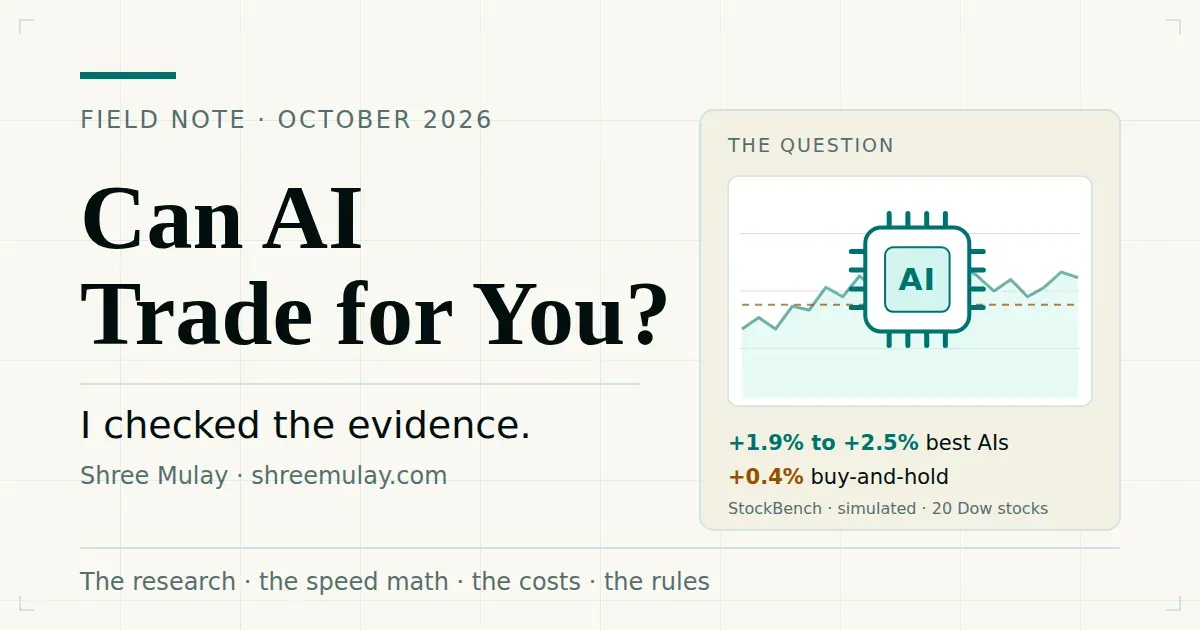
New AI models made me wonder whether I could hand a bot my brokerage account and let it trade for me. Stocks, options, crypto, all through an API, all day long. So I spent a week checking the evidence instead of building first.
This post is what I found. It’s written for anyone, not just people who code. The short version: I’d use AI around my investing, not in charge of it.
Educational only. Not financial, tax or legal advice. Figures are as of late September 2026, and US rules are labeled as US.
TL;DR
- You can absolutely BUILD an AI trading bot. Brokers have APIs, the models exist, servers are cheap.
- Whether it beats doing nothing after costs is a different question, and the evidence says probably not.
- In the best independent test I could check, top AI agents beat buy-and-hold by about 1.5 to 2 percentage points over a few months, in one market window, without stated trading costs. Every one of them did worse than buy-and-hold when prices fell.
- Intraday trading is a speed game, and an AI decision is the slow runner.
- Where AI does help: watching, summarizing, flagging and filtering. Keep the decisions with you or with rules you wrote.
Two questions, two answers
I had to split my idea into two questions, because they have different answers.
“Can I build it?” Yes. Most retail brokers now offer trading APIs. Several publish servers that let AI assistants place orders directly. A small cloud server costs less than a streaming subscription.
“Will it make money after costs, better than doing nothing?” That’s the question that matters, and it’s the one most AI trading demos skip.
Building a race car in your garage is a real accomplishment. Expecting it to beat a Formula 1 team on their own track is a different bet.
What today’s AI actually is
Two kinds of models matter here.
Chat models like Claude, GPT and Gemini write text, reason through problems and call tools. They’re slow by trading standards, roughly half a second to ten seconds per call, and they can be confidently wrong.
Fast decision models are newer. Jev, from TypeSafe AI, launched in early access on September 15, 2026. It doesn’t write text at all. You give it a situation and typed questions, and it returns a pick, a score or a yes/no probability with a confidence number, in about 70 to 500 milliseconds by the company’s own numbers. Laya is an open-source model built to answer the same kind of question, small enough to run on your own machine.
That sounds made for trading. Read the fine print. TypeSafe’s own documentation of Jev’s weak spots lists math and numbers, counting, and comparing dates and time windows, and it names settlement windows specifically. Laya’s builders report that it’s much less accurate until you fine-tune it on your own examples.
None of these models predicts prices. They’re excellent at narrow, repeated judgments: “Is this headline about the company I care about?” “Does this order match the plan I wrote?” Keep that distinction in mind. It comes back at the end.
What the evidence shows
The most useful independent study I found is StockBench, a university benchmark first posted in October 2025 and revised in March 2026.
The setup was simple. Each AI agent started with $100,000 in a simulation and could trade the 20 largest stocks in the Dow. Every morning it decided buy, sell or hold, using its recent actions, a handful of recent news articles and basic company data. The test used 2025 market data, about March through July, that the models couldn’t have seen in training. Each model ran three times.
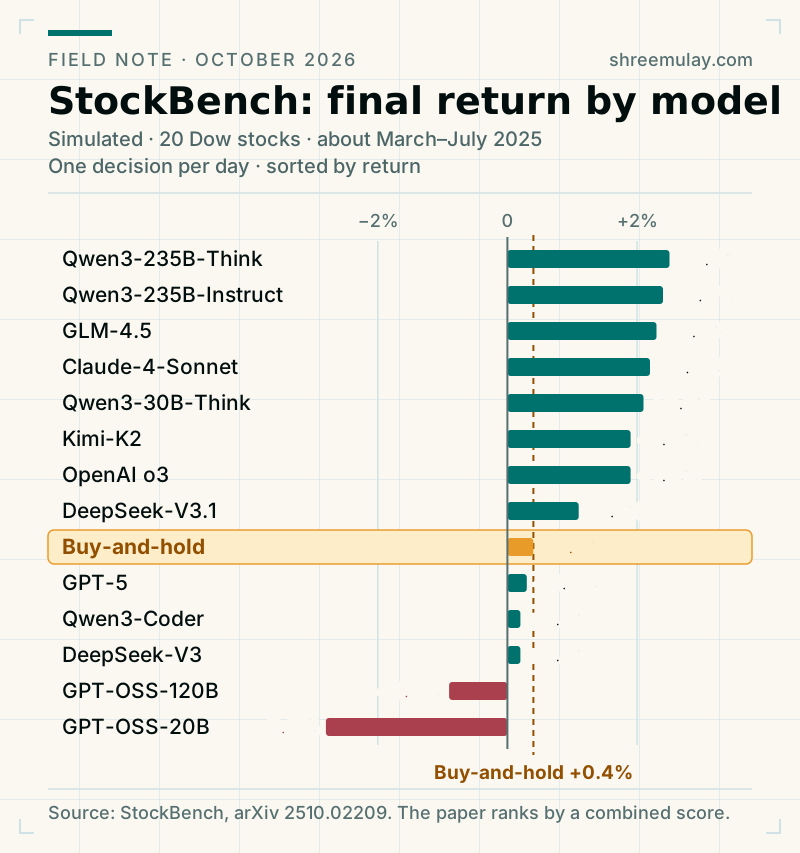
Here’s a slice of the results:
| Model | Return | Worst drop |
|---|---|---|
| Qwen3-235B-Think | +2.5% | −14.9% |
| Qwen3-235B-Instruct | +2.4% | −11.2% |
| Claude-4-Sonnet | +2.2% | −14.2% |
| Kimi-K2 (ranked first overall) | +1.9% | −11.8% |
| GPT-5 | +0.3% | −13.1% |
| Buy-and-hold | +0.4% | −15.2% |
| GPT-OSS-20B | −2.8% | −14.4% |
What I took from it:
- The gains were small. The best agents made about 2 to 2.5% over several months, roughly 1.5 to 2 points better than doing nothing. GPT-5 finished slightly behind buy-and-hold.
- Losing less was the real strength. Every agent’s worst drop was smaller than buy-and-hold’s.
- Market direction decided the outcome. In a separate comparison, every agent did worse than buy-and-hold in the falling window (January to April 2025) and better in the rising one (May to August 2025).
- Smarter didn’t mean better. Reasoning models weren’t reliably ahead, and acing finance quizzes didn’t carry over into trading.
- Costs aren’t stated. I couldn’t find trading fees or slippage in the paper’s setup. That’s my reading, so check it yourself, but a 2% edge is small enough for costs to erase.
And it was one decision per day. Intraday trading wasn’t tested at all.
You may have seen Alpha Arena, a public contest where AI models traded real money while people watched. I couldn’t verify its results from the official site, so I’m not quoting numbers. Even if the screenshots are accurate, one short run per model with no repeats can’t separate skill from luck.
Backtests deserve the same caution. Frameworks like TradingAgents are interesting engineering, but tests on past data tend to look better than live trading, because future information leaks in and costs get left out. As of late September 2026, I found no audited, repeatable record of live AI trading profits.
Why speed kills the intraday idea
Intraday profits mostly go to professional firms whose computers sit inside exchange data centers and react in millionths of a second.
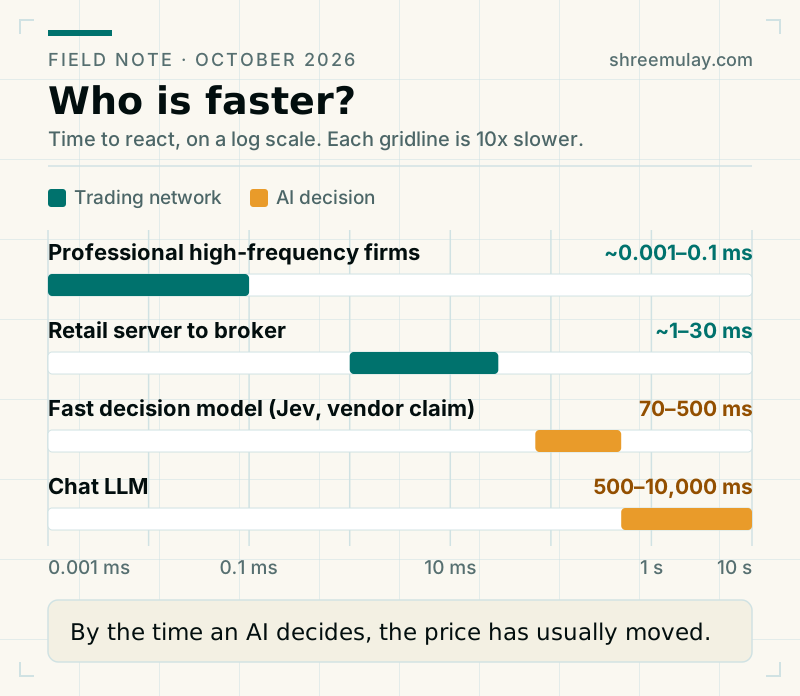
A chat model needs seconds. Even the fastest decision models need tens to hundreds of milliseconds. By the time your AI reads a headline and decides, the price has usually moved, and you’re buying after the move while paying the spread.
That also answers a question I had about servers. Renting a machine next to the exchange saves a few milliseconds of network time. The AI’s thinking time is hundreds to thousands of times longer, so it barely matters.
Showing up to an auction after the gavel falls doesn’t get you the item.
The odds were poor before AI showed up
Research on human day traders is sobering. A widely cited Brazilian study found that among people who day traded persistently, about 97% lost money. Research on Taiwan’s market by Barber, Lee, Liu and Odean found that fewer than about 1% of day traders were reliably profitable year after year. I couldn’t open the primary pages to recheck the exact figures, so treat them as widely reported rather than verified by me.
An AI doesn’t change the arithmetic. Every trade still pays spreads and fees, and the other side of your trade is often a professional.
Costs quietly eat small edges
Here’s the part most demos leave out.
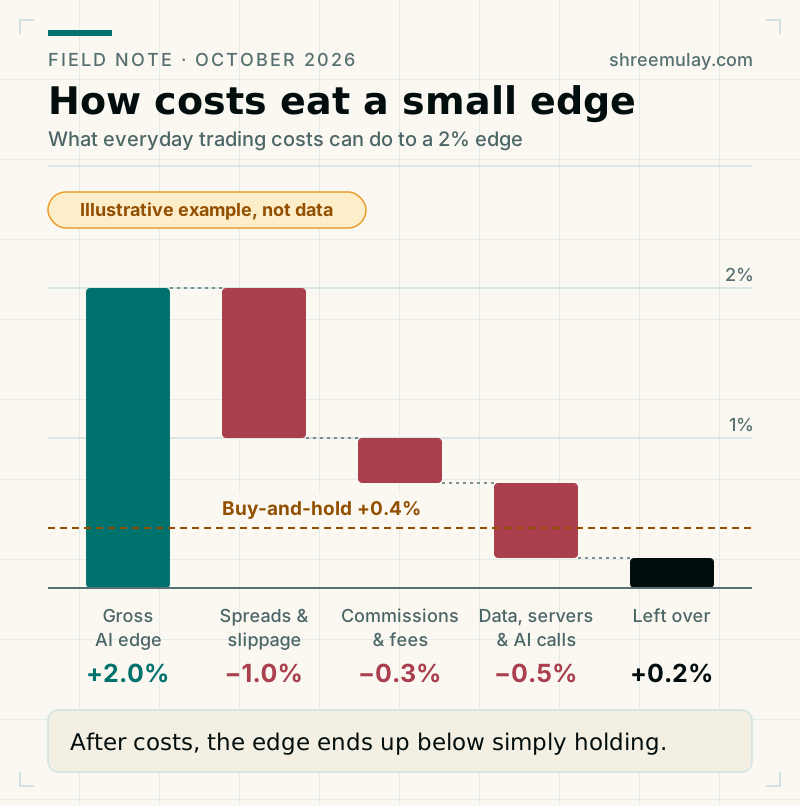
This is an illustration, not data. Start with a 2% edge. Take out spreads and slippage, then commissions and regulatory fees, then market data, servers and AI calls. Taxes come on top in a regular account. What’s left can easily land below simply holding an index fund, which costs a few hundredths of a percent a year and needs no bot.
A strategy has to beat the free, effortless option after every cost, not just make money.
Rules and account types
The rules matter, and they differ by country. These are US examples.
The $25,000 day trading rule is gone. FINRA replaced its pattern day trader provisions with intraday margin standards effective June 4, 2026, with brokers allowed to transition through October 20, 2027. Margin accounts still need at least $2,000 in equity, and brokers can require more. That removes a barrier. It doesn’t improve the odds.
Settlement still applies. Most US stock trades settle the next business day. In a cash account, buying and quickly selling with money that hasn’t settled can trigger violations and restrictions.
Retirement accounts are the wrong test lab. A Roth or traditional IRA has real advantages, but it’s a bad place to experiment:
- Contributions are capped at $7,500 for 2026 ($8,600 if you’re 50 or older), so lost money is slow to replace.
- Losses inside the account aren’t deductible.
- Short selling and ordinary margin borrowing aren’t allowed, and options are limited.
- Selling at a loss in a regular account and buying the same thing in your IRA within 30 days can wipe out that loss for good under IRS Revenue Ruling 2008-5.
Money lost there also loses decades of tax-free growth. That’s the account I’d protect most, not the one I’d experiment with.
Where AI actually helps
This is where I landed, and it’s more useful than it sounds.
| Use | Why it works |
|---|---|
| Watchdog | Flags unusual moves, big drops and rebalancing drift so you look at the right thing at the right time |
| Research help | Summarizes filings, earnings calls and news faster than you can read them |
| Risk filter | Checks every order against rules you wrote before anything is sent |
| Slow, rule-based strategies | Daily or weekly decisions, where speed doesn’t matter and the AI’s loss-limiting shows up |
| Work automation | Routing, scoring and classifying, which is exactly what fast decision models are built for |
That last row surprised me. The most practical thing I learned about models like Jev and Laya had nothing to do with markets. They’re very good at fast, cheap, consistent yes/no and pick-one decisions, and most businesses have thousands of those a day.
If you still want to try
Curiosity is a good reason to build something. Build it so it can tell you the truth:
- Paper trade first. Use a broker’s free simulated account. No real money until it passes.
- Write the pass/fail rules before you start. For example: 60 trading days, results counted after realistic costs, and it must beat buy-and-hold AND a simple rule-based version with no AI.
- Keep the AI out of the money math. Position sizes, limits and a kill switch belong in plain code that the AI can’t override.
- Test through a falling market. Every agent in StockBench struggled there.
- If it fails, stop. Changing the rules after seeing the results is how people fool themselves.
- If it passes twice, try small money you can afford to lose, in a regular account, never retirement money first.
My verdict
| Idea | Verdict |
|---|---|
| A fully autonomous AI day-trading bot with real money | Don’t |
| Index funds, with AI as a watchdog and research helper | Do |
| A paper-trading project with written pass/fail rules | Good for learning |
| Fast decision models for work automation | Do, this is where they shine |
I went in hoping to hand AI the trading. I came out using it to watch, summarize and filter, and keeping the decisions.
What would it take for you to trust an AI with your money?