Why Can't We Solve Dis-ease?
A friend asked why I manage disease instead of preventing it. My answer is a 1975 river story, a waterfall called kidney failure, and a question for AI.
The message came in at 2:26 in the morning, from my friend Sanjeev Bora.
He asked why I spend my time on disease management instead of treatment or prevention. Couldn’t AI fix something that’s stuck in kidney care? Couldn’t we catch people early enough that they never need dialysis?
His last line was the sharpest. Why can’t we solve dis-ease?
Notice the spelling. Dis-ease. It comes back later.
I’m a nephrologist, a kidney doctor, and I build AI systems on the side. Sanjeev was kind enough to let me answer him in public. Here’s my answer.
Educational only. Not medical advice. US figures are the latest I could verify as of November 2026.
TL;DR
- Medicine is built to find disease and rescue people from it. It rarely measures health, and nobody bills for an illness that never happens.
- Much of kidney care already is prevention. It just starts late, because most people with kidney disease don’t know they have it.
- AI will get very good at whatever we measure and pay for. Choosing those targets is the hard part.
What was my first answer?
My gut answer was a list:
- Disease is easier to measure than health.
- Health has no agreed definition.
- Medicine’s history explains a lot.
- Prevention is hard to even talk about.
- There’s too much chronic disease to keep up.
- The money. We’re paid to manage disease, not prevent it.
Then I checked myself. I had AI agents pull the primary sources so I could test each reason. Most held up. A few needed sharpening, and I’ll show you where.
The clearest way I found to explain it is a story about a river.
What does a 1975 river story have to do with dialysis?
In 1975 the medical sociologist John McKinlay opened a paper with a story from his friend Irving Zola. A doctor by a fast river hears someone drowning. He jumps in, pulls him out and starts artificial respiration. Then another cry, and another. The doctor says:
“I am so busy jumping in, pulling them to shore, applying artificial respiration, that I have no time to see who the hell is upstream pushing them all in.”
Sanjeev’s question is at least fifty years old.
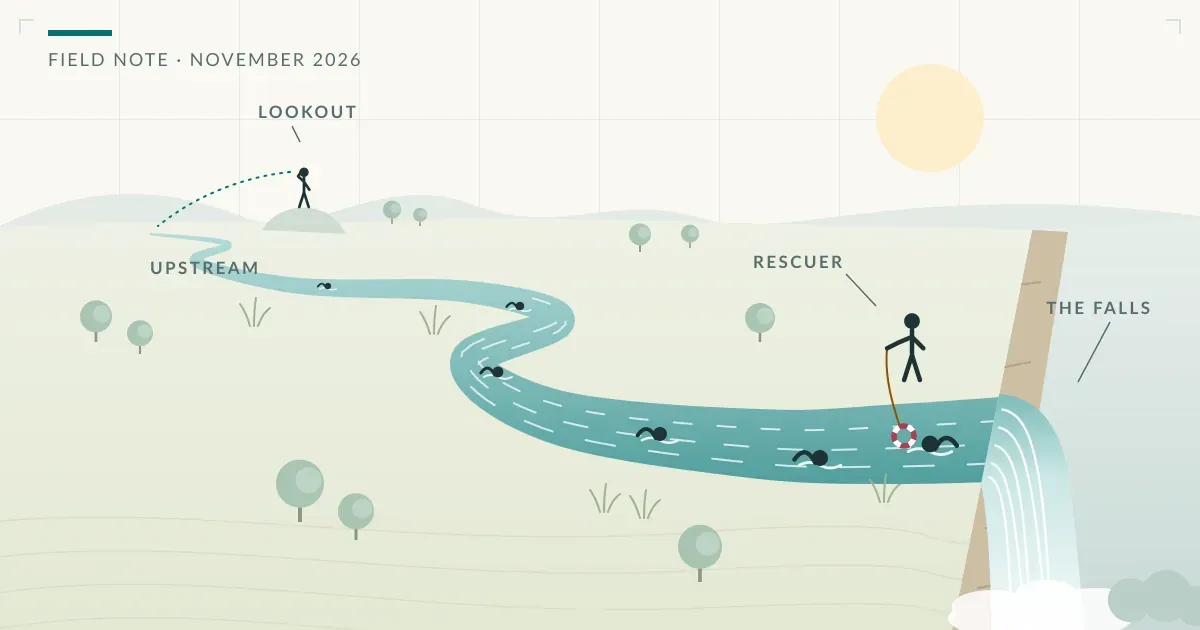
In kidney care, the river ends in a waterfall. The falls are kidney failure. At the bottom is dialysis, which filters the blood when kidneys fail. A nephrologist works the last stretch of the river, close enough to hear the falls.
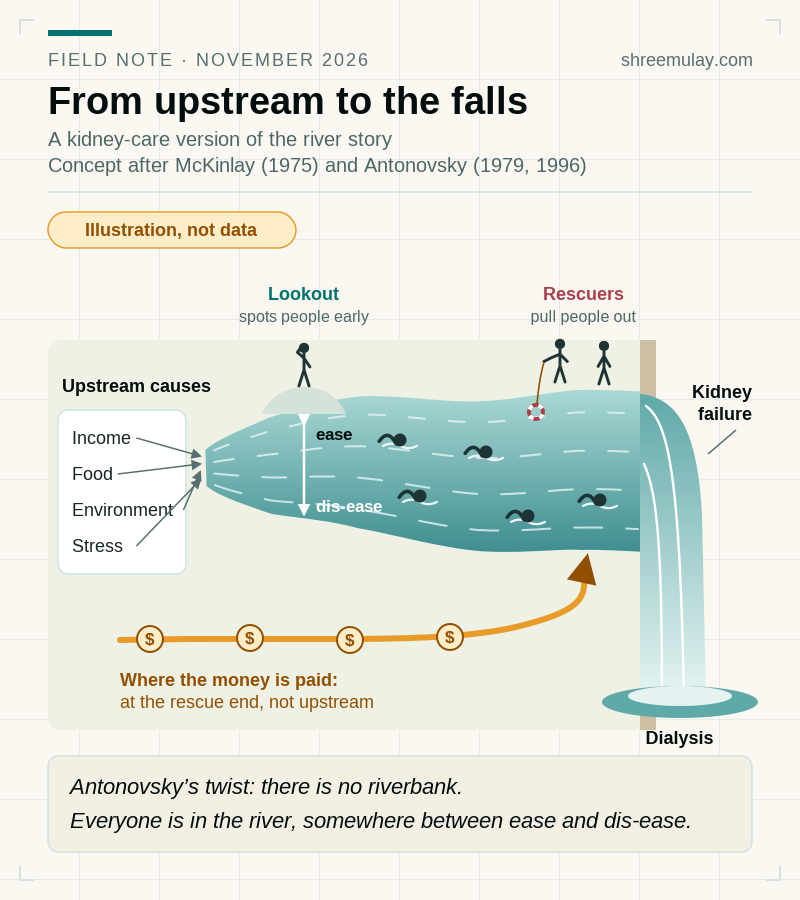
Source: concept adapted from McKinlay (1975) and Antonovsky (1979, 1996). Illustration, not data.
My six reasons are really six reasons doctors stay near the falls.
Why don’t doctors just walk upstream?
1. We can’t see who’s upstream
Medicine mostly sees people once they’re already in the water.
A normal adult physical gets the code Z00.00: “Encounter for general adult medical examination without abnormal findings.” That’s our closest code for healthy. It’s defined by what we didn’t find.
Kidney disease shows the cost. The CDC estimates that 37 million US adults have chronic kidney disease (CKD), meaning lasting kidney damage or lost function. And 87% of adults who have it don’t know.
In one national lab database of more than 28 million adults with diabetes or high blood pressure, 89.6% had a kidney blood test (eGFR). Only 21.0% had a urine albumin test, which looks for leaking protein and often catches kidney damage first.
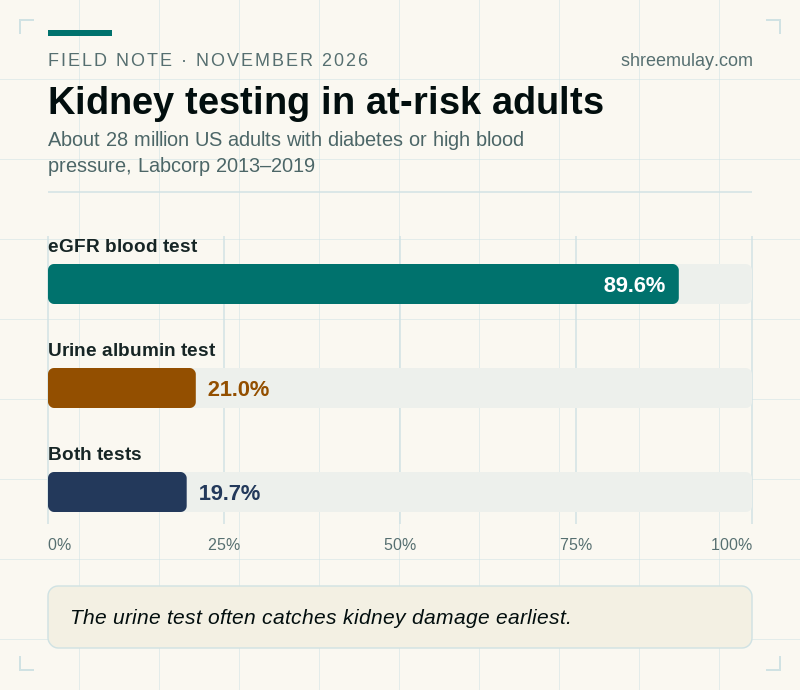
Source: Alfego et al., Diabetes Care 2021, Labcorp patients tested 2013 to 2019. One national lab network, not every US adult.
Here my first answer needed sharpening. We do measure health: fitness, function, quality of life. We do it in research. We rarely do it as a vital sign.
2. We can’t agree where the riverbank is
Prevention needs to know where the bank is. The World Health Organization’s 1946 Constitution says:
“Health is a state of complete physical, mental and social well-being and not merely the absence of disease or infirmity.”
In 1946 that was radical. But “complete” puts almost no one on the bank, and nobody can measure it.
In 2011 a group writing in the BMJ proposed health as “the ability to adapt and self manage in the face of social, physical, and emotional challenges.”
One sharpening here. We can measure specific prevention results, like blood pressure or a kidney test. What we lack is an agreed way to measure health itself.
3. Medicine was built for rescue
Over the last century, especially in the US, medicine and public health split. Medicine took the patient and the cure. Public health took the population and prevention. Then infections gave way to chronic disease, which filled a rescue system.
Kidney care is where rescue became law. In the early 1960s, Seattle had more patients needing dialysis than machines. A citizens’ committee decided who got treatment. In 1962 LIFE ran the headline “They Decide Who Lives, Who Dies.” The public called it the God Committee.
In November 1971 Shep Glazer was dialyzed in front of the House Ways and Means Committee. That moment apparently helped persuade Congress. The Social Security Amendments of 1972 made kidney failure its own route to Medicare, at any age.
The rescue at the bottom of the falls became a national promise. Nobody built anything like it at the top.
4. There isn’t enough time
In 2023, 76.4% of US adults reported at least one chronic condition.
Researchers modeled what it takes for one primary care physician to deliver all guideline-recommended care to 2,500 adults. The answer was 26.7 hours a day.
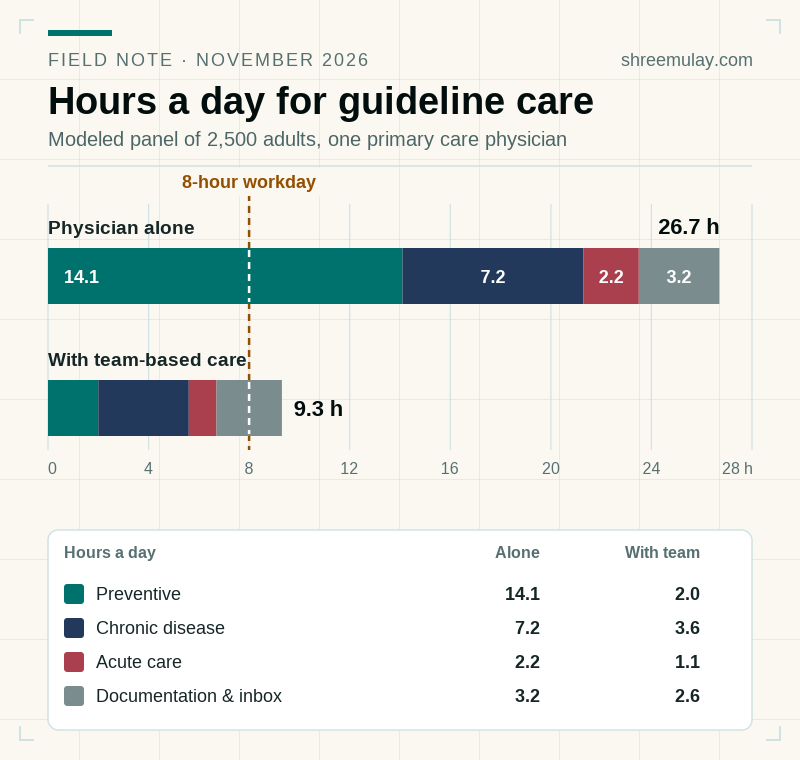
Source: Porter et al., Journal of General Internal Medicine 2023. A simulation of guideline care, not observed workloads.
More than half is preventive care. That’s the walk upstream, and the day runs out first. With team-based care, the same model drops to 9.3 hours.
5. No one bills for what never happens
Here my gut answer needed the most sharpening. We are paid for preventive services. The Affordable Care Act requires most insurers to cover those the US Preventive Services Task Force rates A or B, with no cost sharing.
What we’re mostly paid for is the visit, the test, the procedure. Nobody can bill for the dialysis that never happened. Across OECD countries, prevention gets about 3% of health spending.
People change jobs and insurers. One study found this leads to underinvestment in health during working years. Medicare inherits the cost later. Whoever pays for prevention often isn’t the one who saves.
Medicare tested a kidney care model rewarding earlier, better care. Quality improved: more planned dialysis starts, more home dialysis, more transplants. It also cost Medicare more than it saved in 2023.
Prevention doesn’t have to save money. Many preventive services are good value. Only a few, like childhood vaccines, save money. We don’t ask that of dialysis either.
6. Going upstream can backfire
In 1985 the epidemiologist Geoffrey Rose described the prevention paradox. A measure can help a population a lot and each person in it a little. The person in the exam room mostly sees the inconvenience.
Success is also invisible. When prevention works, nothing happens.
Going upstream can also mean redefining disease. In 1999 researchers modeled proposed lower thresholds for diabetes, blood pressure, cholesterol and overweight. Together they’d label 75% of US adults as diseased.
Done badly, prevention doesn’t keep people out of the river. It just moves the riverbank.
What if there is no riverbank?
Here’s where Sanjeev’s spelling comes back.
The sociologist Aaron Antonovsky used the same river image and saw it differently. To him, there’s no riverbank. Everyone is in the river. The question is how well you can swim.
In 1979 he named the health ease/dis-ease continuum. He called the study of what moves people toward the ease end salutogenesis: the study of what creates health, not what causes disease.
Sanjeev’s spelling is Antonovsky’s word.
So health isn’t a bank, and disease isn’t a switch. It’s a position, and it moves. We can’t solve dis-ease like an equation. We can help people swim, spot them earlier, and keep them away from the falls.
Much of kidney care is already prevention that starts late. Since 2020, large trials have shown several medicines can slow kidney disease. What’s missing is finding people early.
Could AI be the lookout?
In 2019 a research model built on hospital records predicted acute kidney injury up to 48 hours ahead. It caught 55.8% of inpatient episodes and 90.2% of cases that went on to need dialysis, with about two false alerts per true one.
It was tested on past data, so it doesn’t prove patients were better off. Impressive, and a faster rescue boat.
The risk: AI optimizes whatever we measure and pay for. Pay for rescue and we get faster rescue, and maybe faster overdiagnosis.
AI could be a lookout instead, helping find people with kidney disease who don’t know they have it. Team-based care already cuts the modeled day to 9.3 hours. AI might help teams get closer, but that study didn’t test AI. It could also track how well people adapt over years, not one threshold.
Most of that doesn’t need a better model. It needs us to decide what the model should look for.
So what’s my answer, Sanjeev?
Here it is, question by question.
| You asked | My answer |
|---|---|
| Why disease management instead of prevention? | Medicine routinely measures disease and rarely measures health, there’s too little time, and payment mostly rewards rescue. Much chronic care is late prevention. |
| Couldn’t AI fix what’s stuck in nephrology? | It can help, but it will optimize whatever we measure and pay for. Point it at finding people early, not just predicting failure. |
| Couldn’t we treat early enough to avoid dialysis? | Often, yes. Several medicines can slow kidney disease. The bottleneck is finding people early, since most with kidney disease don’t know they have it. |
| Why can’t we solve dis-ease? | Dis-ease isn’t a problem with one solution. It’s a position on a continuum. Everyone’s in the river. The job is helping people swim. |
So here’s my question back to you, Sanjeev, and to anyone reading. If you had to prove you’re healthy, not just “without abnormal findings,” what would you measure?
What this does not claim
- It doesn’t claim prevention isn’t worth doing, or that medicine fails at it everywhere.
- It doesn’t claim modeled workloads or historical estimates describe any single clinic.
- It doesn’t claim any medicine, test or AI tool is right for you. Talk to your own clinician.
- It doesn’t claim AI prediction has been shown to improve outcomes, and it doesn’t describe any patient.
Sources
The question and the river
- McKinlay JB. A case for refocusing upstream: the political economy of illness. 1975, reprinted by IAPHS. Quotes Irving Zola (1970).
- Antonovsky A. Health, Stress and Coping. 1979. Overview in Aaron Antonovsky’s Development of Salutogenesis, 1979 to 1994, The Handbook of Salutogenesis.
- Antonovsky A. The salutogenic model as a theory to guide health promotion. Health Promotion International. 1996.
Measuring disease, defining health
- ICD-10-CM Z00.00: Encounter for general adult medical examination without abnormal findings.
- CDC. Chronic Kidney Disease in the United States. March 2026.
- Alfego D et al. Chronic kidney disease testing among at-risk adults in the U.S. remains low. Diabetes Care 2021;44:2025–2032.
- World Health Organization. Constitution of the World Health Organization. 1946.
- Huber M et al. How should we define health? BMJ 2011;343:d4163.
History
- Brandt AM, Gardner M. Antagonism and accommodation. Am J Public Health 2000;90:707–715.
- Omran AR. The epidemiologic transition. Milbank Memorial Fund Quarterly 1971.
- Alexander S. They Decide Who Lives, Who Dies. LIFE, November 9, 1962.
- Rettig RA. Origins of the Medicare kidney disease entitlement. Institute of Medicine, 1991.
- RAND Corporation. Paper P-5672, describing Shep Glazer’s 1971 testimony.
- Congressional Research Service. Medicare Coverage of End-Stage Renal Disease.
Time and money
- Watson KB et al. Trends in multiple chronic conditions among US adults. Prev Chronic Dis 2025;22:240539.
- Porter J et al. Revisiting the time needed to provide adult primary care. J Gen Intern Med 2023;38:147–155.
- Supreme Court of the United States. Kennedy v. Braidwood Management. 2025.
- OECD. Health expenditure on prevention and primary healthcare. Health at a Glance 2025.
- Fang H, Gavazza A. Dynamic inefficiencies in an employment-based health insurance system. Am Econ Rev 2011.
- CMS. Kidney Care Choices Model Performance Year 2026 Model Update.
- Cohen JT, Neumann PJ, Weinstein MC. Does preventive care save money? NEJM 2008;358:661–663.
Going upstream
- Rose G. Sick individuals and sick populations. Int J Epidemiol 1985;14:32–38.
- Schwartz LM, Woloshin S. Changing disease definitions: implications for disease prevalence. Eff Clin Pract 1999;2:76–85.
Kidney care and AI
- Heerspink HJL et al. Dapagliflozin in patients with chronic kidney disease. NEJM 2020.
- EMPA-KIDNEY Collaborative Group. Empagliflozin in patients with chronic kidney disease. NEJM 2023.
- Perkovic V et al. Effects of semaglutide on chronic kidney disease in patients with type 2 diabetes. NEJM 2024.
- Tomašev N et al. A clinically applicable approach to continuous prediction of future acute kidney injury. Nature 2019;572:116–119.