Which AI Model Is Best for Coding? What My Own Usage Says
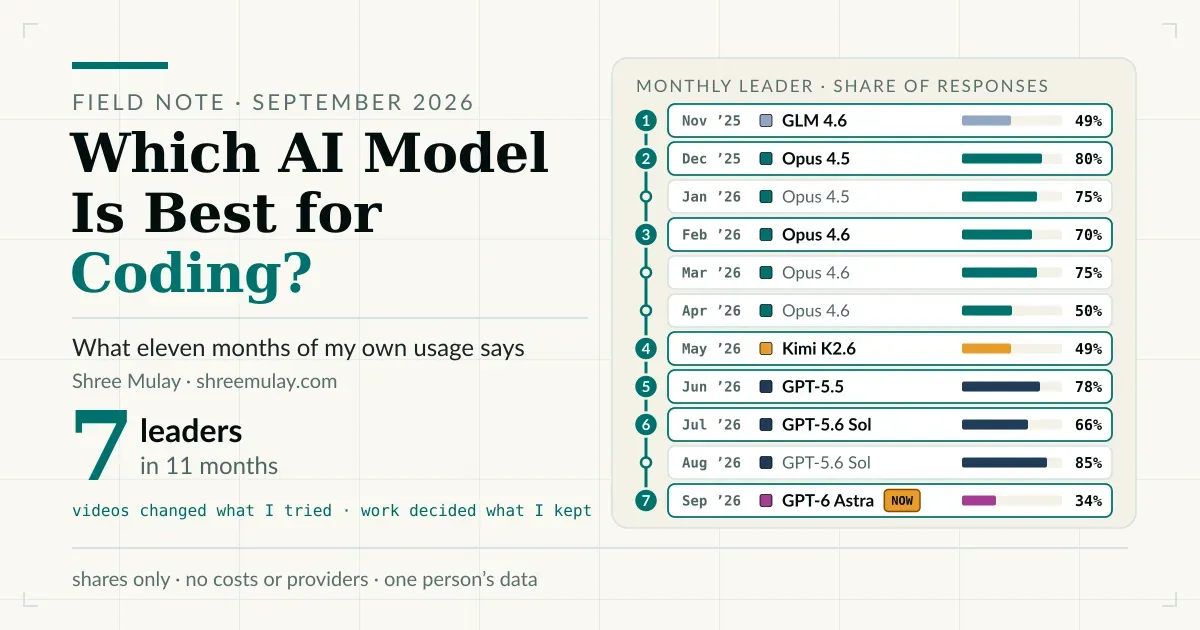
7 leaders in 11 months: which AI model is best for coding, from my own usage data matched against 3,858 videos I processed, and what actually made me switch.
TL;DR
There is no single best AI model for coding in my data. The leader changed seven times in eleven months. Today GPT-6 Astra and GPT-5.6 Sol carry two thirds of my work, with Claude Fable 5.1 behind them. What I learned from matching the 3,858 videos I processed against my own usage: videos changed which models I TRIED. Releases, prices and plan rules decided which ones I KEPT.
Key takeaways:
- Seven different models led my usage in eleven months, from GLM 4.6 to GPT-6 Astra.
- Kimi K2.6 is the clean case of influence: 23 videos first, then half my usage in May, gone by June.
- Most big switches happened on launch day, when the videos and my first use landed together.
- The longest runs came from Claude Opus 4.6 and GPT-5.6 Sol, not from the models with the loudest coverage.
- I was using GLM two months before the first GLM video in my library.
How did I measure which AI model I used?
I counted. Every response in my OpenCode history is tagged with the model that produced it. I grouped those into model families, counted them by day and month, and converted the counts to shares. No costs, no providers, no prompt text left my machine.
On the video side, each Clarity Engine video has a date, channel and title. I matched titles against the same model names.
This is one person’s data. It shows timing, not cause. Where a video is linked straight into a working session, I say so, because that is the closest thing to proof I have.
For the channels themselves, see The AI YouTube channels I actually watch.
Quick glossary
- Model family: every version and speed setting of one model grouped under one name, such as GPT-5.6 Sol.
- Share: a model’s percentage of all AI responses in my coding sessions for that period.
- 7-day rolling share: the same percentage over the trailing seven days, which smooths out single busy days.
- Launch-day switch: a model I first used on, or one day after, the day it and its first videos appeared.
- Kept: a model whose 7-day share stayed at 10% or more for at least a few weeks.
Which AI model led my coding each month?
Seven different models led in eleven months.
| Month | Top model | Share |
|---|---|---|
| Nov 2025 | GLM 4.6 | 49% |
| Dec 2025 | Claude Opus 4.5 | 80% |
| Jan 2026 | Claude Opus 4.5 | 75% |
| Feb 2026 | Claude Opus 4.6 | 70% |
| Mar 2026 | Claude Opus 4.6 | 75% |
| Apr 2026 | Claude Opus 4.6 | 50% |
| May 2026 | Kimi K2.6 | 49% |
| Jun 2026 | GPT-5.5 | 78% |
| Jul 2026 | GPT-5.6 Sol | 66% |
| Aug 2026 | GPT-5.6 Sol | 85% |
| Sep 2026 | GPT-6 Astra | 34% |
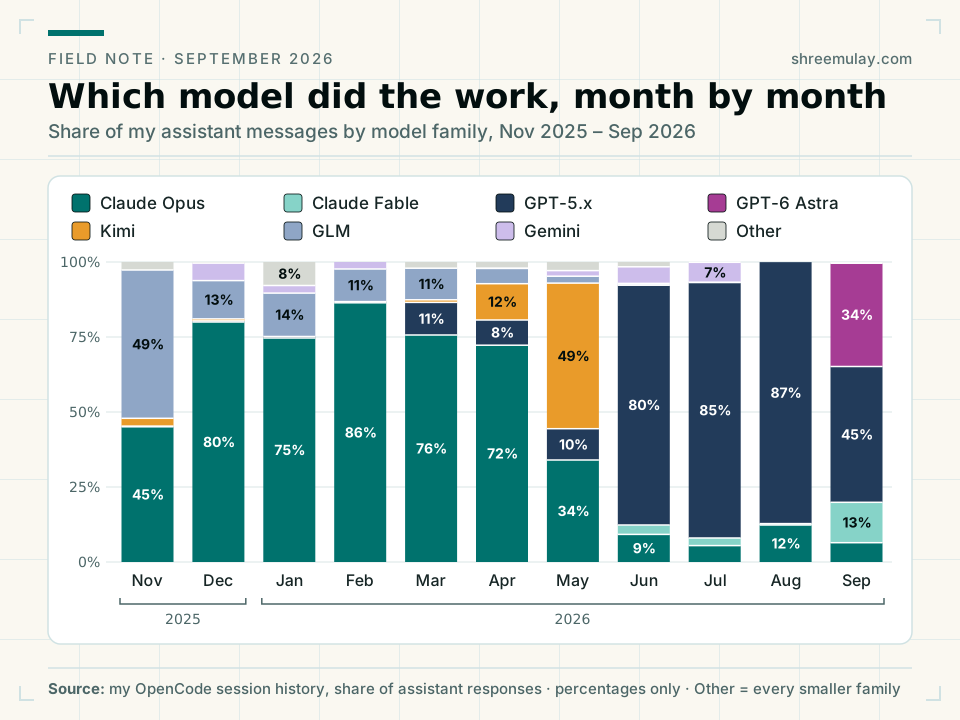
Source: my OpenCode session history, share of AI responses by model family per month. GPT-5.x groups every GPT-5 version, so June reads 80% here against 78% for GPT-5.5 alone in the table.
September is the first month in a while with no single model above half: GPT-6 Astra at 34%, GPT-5.6 Sol at 33%, Claude Fable 5.1 at 13% and GPT-5.6 Luna at 12%.
If you want one answer to “which AI model is best for coding”, my data says the answer has a shelf life of about a month.
Did YouTube videos change which coding model I used?
Sometimes, and rarely the way it looks. I sorted every model into a pattern by comparing three dates: its first video, my first use, and the day it first reached 10% of my usage.
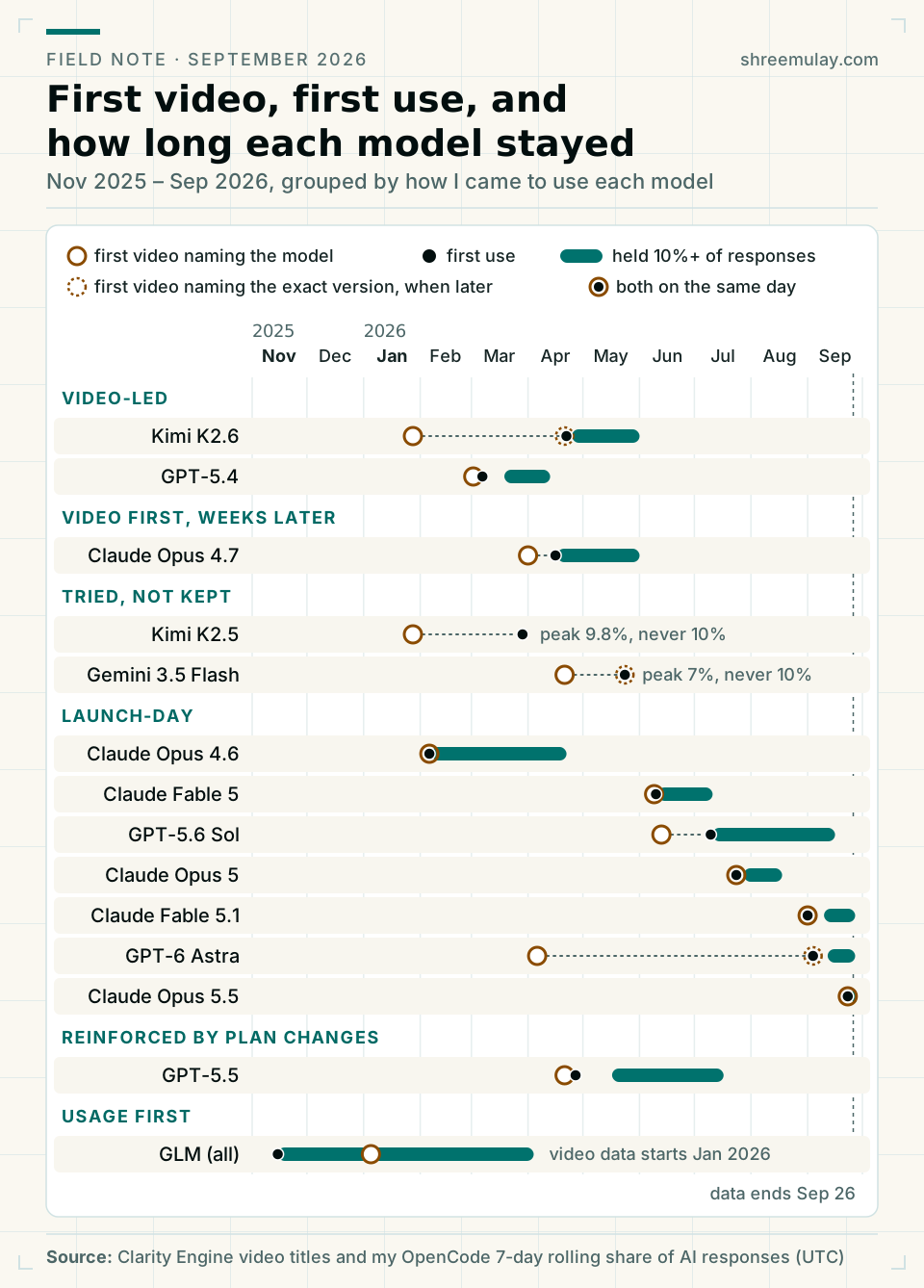
Source: my Clarity Engine video titles and OpenCode 7-day rolling share of AI responses. Dates in UTC.
Case 1: Kimi K2.6, where the videos came first
This is the one that looks exactly like influence.
The first Kimi video I processed was AICodeKing’s Kimi K2.5 test on January 28. By late April the channels I follow were full of it. In the week of April 20 alone I processed 24 Kimi videos, including WorldofAI’s BEST Opensource AI Model That Beats Opus 4.6.
I had processed 23 Kimi videos before I sent my first request to K2.6 on April 22. Three days later it was above 10% of my usage. On May 4 it handled 96.7% of my responses on a 7-day basis. For the month of May it was 49%, my top model.
Then it faded. It was below 10% by the start of June and near zero by June 6.
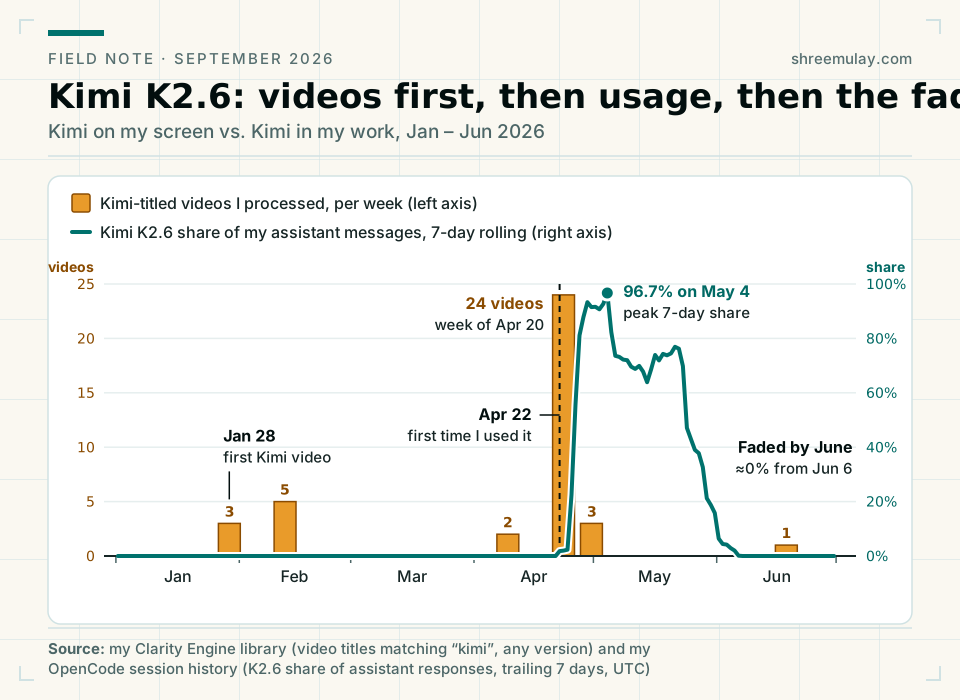
Source: Kimi-titled videos in my Clarity Engine library per week, and my OpenCode 7-day rolling share for Kimi K2.6.
I do not have a clean record of why it faded. June is also the month GPT-5.5 became my default at 78%, so the simplest reading is that something I preferred arrived. The videos got me to try Kimi. They did not keep it there.
Case 2: GPT-5.4, same pattern, smaller
Nine GPT-5.4 videos landed in my library by March 7, including Nate B Jones on the GPT-5.4 leak and a production database story. I first used it March 7 and it reached 11% of my usage that month.
Useful, never dominant. It was a second opinion next to Opus 4.6 for four weeks, not a replacement.
Case 3: the ones I tried and dropped
Kimi K2.5 had eight videos before I tried it in late March. Its 7-day share peaked at 9.8% and never reached 10%.
Gemini 3.5 Flash showed up in WorldofAI’s April roundup a month before I used it. It peaked around 7%.
Those are the quiet majority. A video gets a model onto my list. Most models do not stay there.
Case 4: launch day, not the review
For most big releases, the videos and my switch happened on the same day.
- Claude Opus 4.6: Matthew Berman’s launch video and my first use were both February 6.
- Claude Fable 5: first video June 9, first use June 10.
- Claude Opus 5: launch video and first use both July 24.
- Claude Fable 5.1: launch video and first use both September 1.
- Claude Opus 5.5: a side-by-side test and first use both September 23.
That is not a video persuading me. That is a launch moving everyone at once, creators included. I was already watching for it.
The exception worth naming is GPT-6 Astra. On September 3 I pasted Theo’s My New Favorite Model straight into a working session. I first used Astra the next day, and by September 12 it was over 10% of my usage. That is the most direct video-to-switch link in my data.
Case 5: the big move that videos did not cause
Between April and August my usage moved from mostly Claude Opus to mostly GPT-5.5, then GPT-5.6 Sol. Sol held 85% of my responses in August.
There were plenty of GPT videos in that window. But the move lines up just as well with something else: Anthropic changed what a subscription would cover for outside tools in April, and changed it again in May and June. I wrote up that trail in How I got Opus back.
Plan rules and price changed my defaults more than any creator did. The videos told me what the alternatives were.
Case 6: where I was ahead of the videos, and where I was not
GLM was 49% of my usage in November 2025. The first GLM video in my library is a GLM 4.7 build tutorial on January 5, 2026. I was not following anyone into that one.
LLM councils, where several models answer the same question and the answers get merged, are murkier. My first council sessions and the first council video in my library both fall in January 2026. Prompt Engineering’s later Does LLM Council/Fusion Actually Work? confirmed an approach I was already using. I cannot say which came first.
Which AI coding models did I actually keep?
The ones I kept longest were not the ones with the loudest launches.
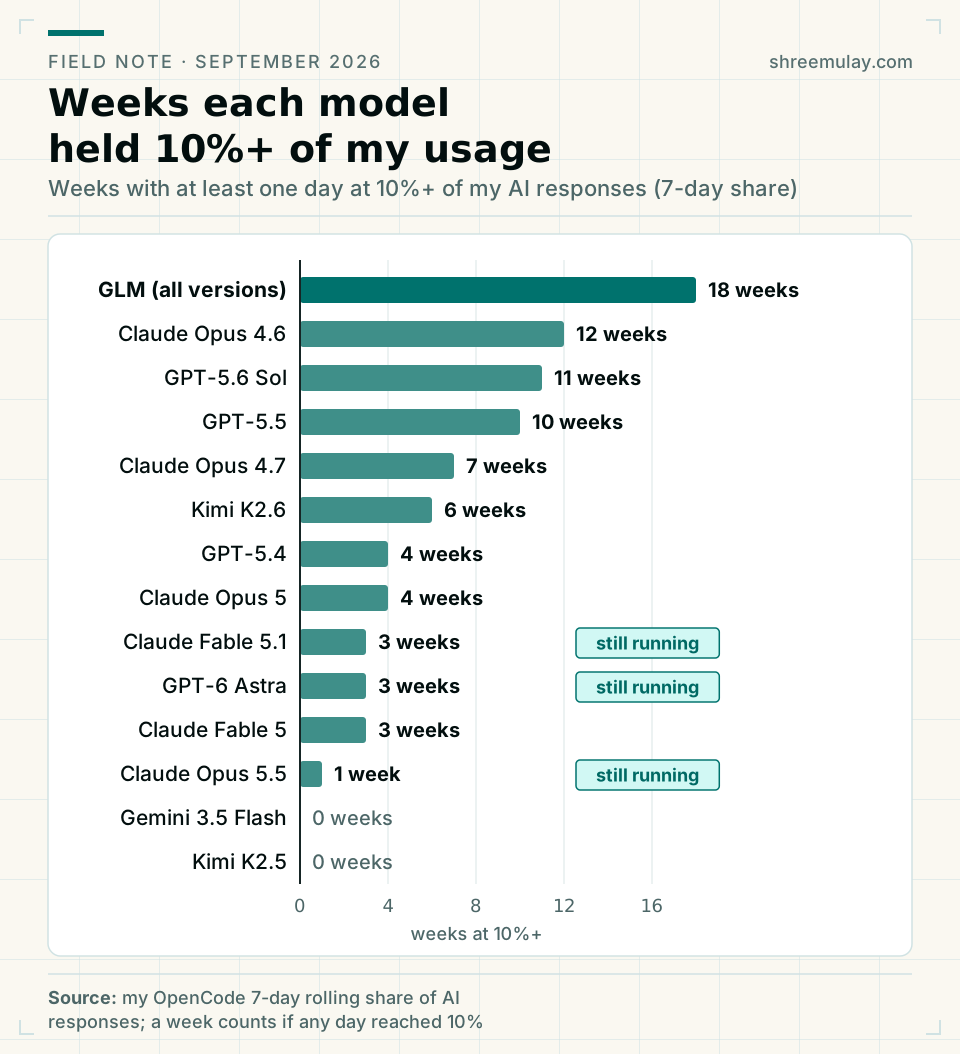
Source: my OpenCode 7-day rolling share of AI responses. A week counts if the share reached 10% on any day that week. GPT-6 Astra, Fable 5.1 and Opus 5.5 are still running.
GLM held 10% or more for 18 weeks, the longest of anything, and no video put it there. Claude Opus 4.6 held for 12 weeks, GPT-5.6 Sol for 11 and GPT-5.5 for 10. Kimi K2.6 peaked higher than any of them and lasted six.
Loud titles did not predict retention either. By the same title-style rule I used on the channels, 75% of Kimi K2.5 titles were loud and I never kept it; 11% of GPT-5.5 titles were loud and I kept it for ten weeks. Small numbers, but the direction matches everything else here.
What this changed about how I watch
I watch for what to try, not for what to use. A video is a reason to run a model against my real tasks for a few days. It is never the verdict.
Retention is the real review. Kimi K2.6 lasted six weeks. GPT-5.6 Sol has held a large share since July. Nothing in either model’s launch coverage predicted that.
Launch-day videos are news, not evidence. They tell me something shipped. My own tasks tell me if it is good.
Plan rules and price beat benchmarks. Twice this year my default changed because of what a subscription covered, not because of a new score.
What this does not claim
- This is one person’s usage, on my own kind of work. It is not a benchmark.
- Timing is not cause. Only the GPT-6 Astra case has a video linked directly into a working session the day before first use.
- Shares are of AI responses, not of hours, tasks or quality. A busy week of one kind of work can move a share.
- July’s raw volume jumped because I started fanning work out to subagents, which is why I compare shares, not counts.
- I publish no costs, providers, or raw counts, so this cannot tell you which model is cheapest.
Try this yourself
Most coding tools log which model answered each request.
- Export or tally your requests by model for the last three months.
- Group versions into families and compute each family’s share per week.
- Mark the day each model launched and the day you first used it.
- Circle any model that passed 10% and then fell below it within six weeks. Ask what you were watching that month.
So, what is the best LLM for coding?
For me, today: GPT-6 Astra and GPT-5.6 Sol carry most of the work, Claude Fable 5.1 handles the planning I care most about, and Opus 5.5 is too new to judge.
Since then I put Opus 5.5 head to head with GPT-6.1 Sol Ultrafast on real jobs: How I tested two AI coding models.
Ask me in a month. My own data says the answer will have moved.
What would you want to see measured next?
For the channels behind this data, see The AI YouTube channels I actually watch.