The AI YouTube Channels I Actually Watch
3,858 videos later: the best AI YouTube channels I actually watch, ranked by my own viewing data, with the exact videos I learned from on each channel.
TL;DR
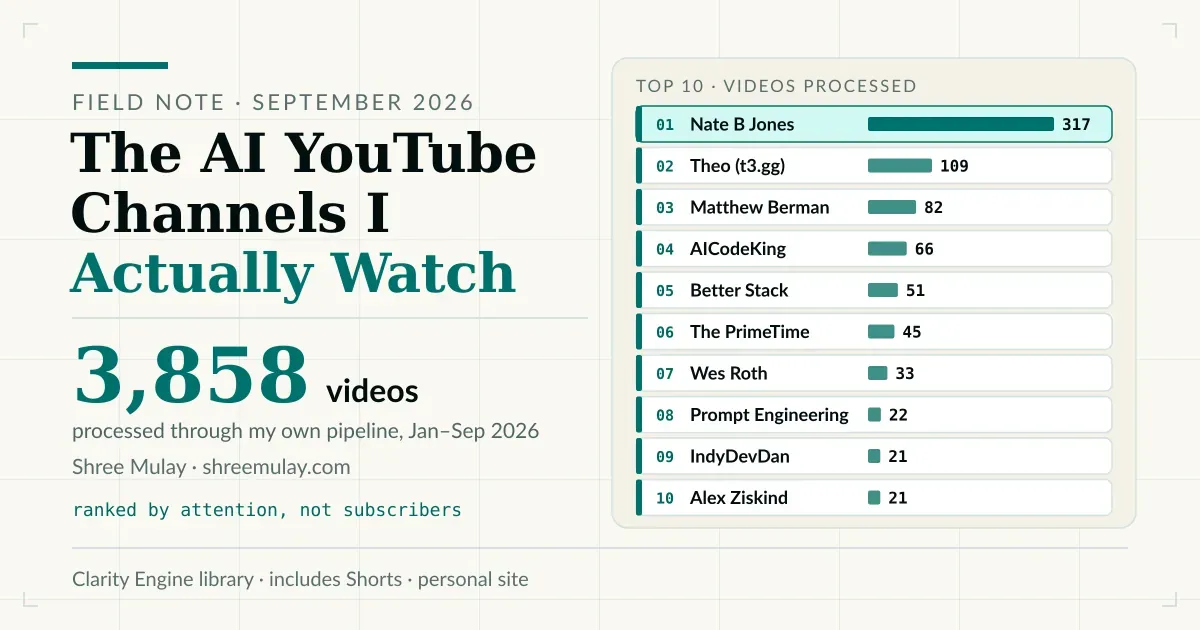
The best AI YouTube channels, for me, are the ones I kept coming back to. I counted: since January 2026 I have run 3,858 YouTube videos through Clarity Engine, my own video analysis pipeline. Ranked by that count, my top ten AI channels are Nate B Jones, Theo, Matthew Berman, AICodeKing, Better Stack, The PrimeTime, Wes Roth, Prompt Engineering, IndyDevDan and Alex Ziskind.
Key takeaways:
- Nate B Jones leads by a mile at 317 videos, because he is the only channel I auto-subscribe to.
- Each channel has a job. Strategy, release news, coding-model tests, how to build, and reality checks are different jobs.
- I read far more than I watch. A summary decides whether a video earns my full attention.
- Loud titles are not a verdict. My loudest-titled channel still ran some of the most useful tests.
- My attention moves. One channel went from 18 videos in January to almost none after April.
The top 10 at a glance
| Rank | Channel | Videos | Best for |
|---|---|---|---|
| 1 | Nate B Jones (AI News & Strategy Daily) | 317 | AI strategy for operators |
| 2 | Theo (t3.gg) | 109 | Picking a daily coding model |
| 3 | Matthew Berman | 82 | Same-day release coverage |
| 4 | AICodeKing | 66 | Side-by-side coding tests on a budget |
| 5 | Better Stack | 51 | New developer tools |
| 6 | The PrimeTime | 45 | The skeptical counterweight |
| 7 | Wes Roth | 33 | News plus the research behind it |
| 8 | Prompt Engineering | 22 | How the mechanism works |
| 9 | IndyDevDan | 21 | Agentic engineering practice |
| 10 | Alex Ziskind | 21 | Local AI hardware, measured |
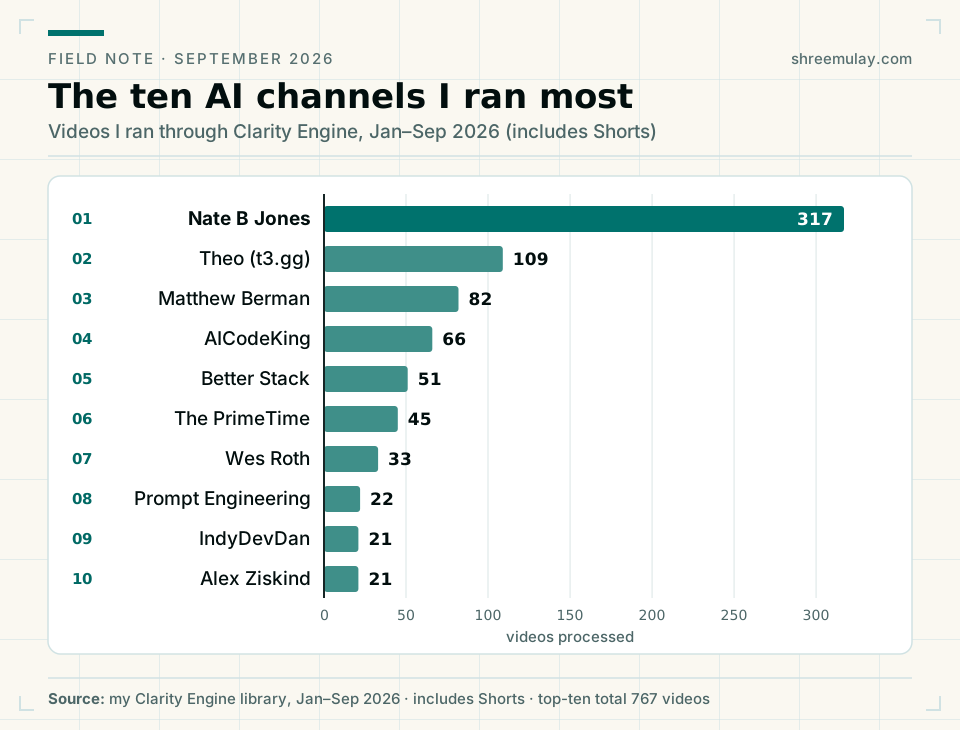
Source: my Clarity Engine library, January 5 to September 26, 2026. Counts include Shorts.
How do I know which AI channels I actually watch?
I measure it. Clarity Engine takes a YouTube link and runs it through a pipeline of agents: transcription, key moments, concept extraction, validation, gap finding, and a final synthesis into a private dashboard.
That gives me something most “best AI YouTubers” lists do not have. Every video has a date, a channel, a category and a set of extracted concepts. I can ask which channels I kept coming back to, and what I took from them, without trusting my memory.
The counts below cover January 5 through September 26, 2026. 73 videos with no channel metadata are left out, so every number is a floor.
Quick glossary
- Clarity Engine: my own tool that turns a video into a transcript, concepts and a summary dashboard.
- Processed video: a video I sent through Clarity Engine. Not the same as an hour watched.
- Shorts: YouTube’s vertical clips under a minute. They count here, and I say where they skew a number.
- Harness: the wrapper of tools, context and rules around an AI model that turns it into an agent.
- Frontier model: the newest, most capable model a lab offers.
1. Nate B Jones (AI News & Strategy Daily): 317 videos
Nate is the only channel I subscribe to automatically. Every new upload lands in Clarity Engine without me touching it, which is why his number is so far ahead. 103 of those 317 are Shorts.
Why I watch: he talks about AI the way an operator should. Less “this model is insane”, more “what does this change about how work gets done”. Recent uploads had him at NVIDIA asking when AI will make scrambled eggs, at OpenAI asking whether your computer now belongs to Codex, and a beginner’s guide to ChatGPT Work.
What I took away: his argument that AI slop is an authorship problem, not a model problem, changed how I write. My own voice skill credits him directly. I wrote about that in How I found my voice in 13,839 messages.
Best for: leaders and builders who want strategy and practical framing rather than benchmark scores.
2. Theo (t3.gg): 109 videos
Theo is where I go when a new model drops and I want an opinion from someone who actually codes with it. His last week alone: Anthropic Actually Fixed Opus, Getting the most out of Opus 5.5, and I was using Fable wrong.
Why I watch: he is opinionated and changes his mind in public. Please stop using stupid models is a strong title, but the substance is sound: the floor of a model matters as much as its ceiling.
What I took away: prompt wider. Hand the agent the whole multi-phase task with a clear definition of done, instead of feeding it one step at a time. That is now how I brief my own agents.
Best for: developers picking a daily coding model.
3. Matthew Berman: 82 videos
Matthew is my fastest read on what shipped: GPT-6 Sol and Luna, Gemini 3.8 Flash, and two Jev videos eight days apart.
Why I watch: he covers releases the day they land and shows the model doing something, not just the benchmark table.
What I took away: his Jev coverage reframed a category for me. Jev is a decision engine, fast and cheap, built for structured classification rather than open-ended text. His follow-up on eight Jev use cases made the point concrete: not every step in an agent pipeline needs a frontier model.
Best for: staying current on releases in fifteen minutes a day.
4. AICodeKing: 66 videos
AICodeKing tests models on coding tasks, side by side, and is loudest about free and cheap options: GPT-6 Sol vs Opus 5.5, Minimax M3 with a free API, Claude Code vs Codex vs GLM vs Kimi.
Why I watch: the tests are concrete, and he cares about cost as much as capability.
What I took away: his value equation. Intelligence per dollar per usage limit, not intelligence alone. His Sol versus Opus 5.5 comparison put Sol at roughly half the token price, with Opus ahead on quality. That is the trade I make every week.
Best for: developers on a budget, and anyone curious about open-weights coding models.
He is also my clearest example of attention moving. I processed 18 of his videos in January and 15 in each of February and March, then almost none after April. More on what that coincided with in the companion post.
5. Better Stack: 51 videos
Better Stack is the channel that finds the tool I did not know I needed: an open-source tool that makes Claude draw architecture diagrams, DeepSeek V4 Flash for cheap tokens, TanStack’s new charts, and a tiny engine that runs big models locally.
Why I watch: short, practical, developer-first, and not tied to one lab.
What I took away: the architecture-diagram video explained why a structured intermediate layer between the agent and the rendered picture beats asking a model to draw directly. Validate the structure, then render it.
Best for: developers who want tools, not takes.
6. The PrimeTime: 45 videos
ThePrimeagen is my counterweight. He is skeptical by default, funny about it, and right often enough that I pay attention: How are they Losing so Bad, Cursor’s GitHub Replacement, and This Might Be the Best AI Release of 2026.
Why I watch: he keeps me honest about demo porn, his name for impressive AI demos that are not real products.
What I took away: when a skeptic calls something the best release of the year, I take a second look.
Best for: engineers who want the craft conversation without the hype.
7. Wes Roth: 33 videos
Wes covers big-picture AI news: new frontier models, lab drama, safety research. GPT-5.6 is here, Grok 4.5 just COOKED Claude and OpenAI.
Why I watch: he covers the research behind the launches, not just the launches.
What I took away: in Anthropic just confirmed everyone’s worst fear, he walks through research showing that smarter models do not automatically coordinate better. That matched what I saw running parallel agents myself: more agents is not the same as more progress.
Best for: people who want the news cycle and the research behind it. Skip the thumbnails.
My count for Wes peaked at 13 in February and stops in mid-August. Over the same stretch my list tilted toward engineering channels.
8. Prompt Engineering: 22 videos
Prompt Engineering is the most technical channel on this list: speculative decoding from DeepSeek, what makes GLM 5.2 special, and a small model that does function calling without an LLM.
Why I watch: he explains the mechanism, not just the result.
What I took away: Does LLM Council/Fusion Actually Work? was a careful look at running several models on one question and merging the answers. I was already running a council setup before that video, so it confirmed more than it changed.
Best for: engineers who want to know why something works.
9. IndyDevDan: 21 videos
Dan teaches agentic engineering as a discipline: software factories, agent sandboxes, system prompts as law.
Why I watch: his content is the closest to how I actually build.
What I took away: his trade-off triangle of performance, speed and cost, from how he ranks Astra, Fable 5.1 and open-weights models. Aggregate benchmark scores hide what matters; rank models on the benchmarks that match your work. In April I linked his Pi coding agent video straight into a working session and set it up the same day.
Best for: engineers building multi-agent systems in production.
10. Alex Ziskind: 21 videos
Alex runs large models on local hardware and measures honestly: a DGX Spark wired to a Mac Studio for one model, the AMD box that rivals it, and a model that looked good until he checked the hallucinations.
Why I watch: he tests recall at depth and hallucination rates, not just tokens per second.
What I took away: a benchmark that only measures speed is incomplete. Check what the model gets wrong.
Best for: anyone deciding whether local AI hardware is worth buying.
WorldofAI tied Alex at 21. I gave the spot to Alex because his most recent video was newer and the testing is more rigorous.
When did I watch each channel?
Attention is not steady. The heatmap shows each top-ten channel by month.
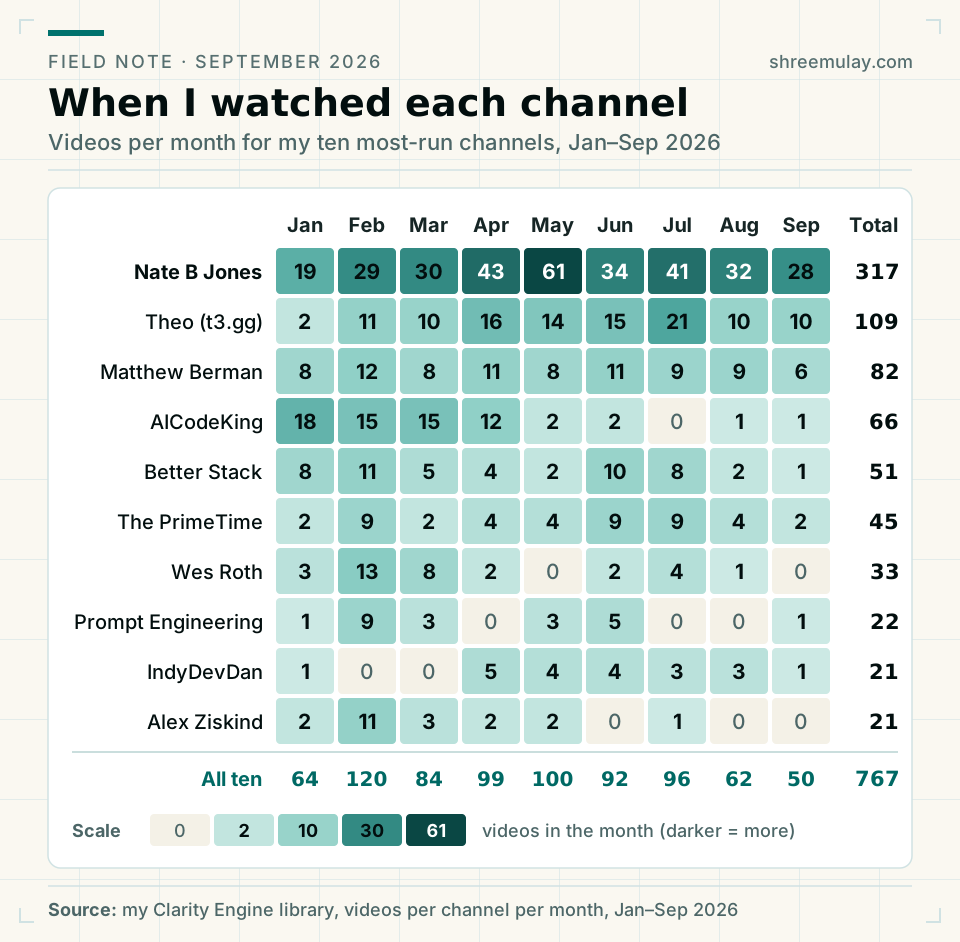
Source: my Clarity Engine library, videos per channel per month, January to September 2026.
Three patterns stand out. Nate B Jones is steady every month because he is automatic. Theo grew as I shifted toward daily coding-model decisions, peaking at 21 in July. AICodeKing and Alex Ziskind were early-year habits: AICodeKing had 18 in January, Alex 11 in February, and both faded after spring.
Honorable mentions
These did not make the top ten by count, but I learned something specific from each.
| Channel | Videos | What I go there for |
|---|---|---|
| AI Engineer | 24 | Conference talks on harnesses, recursive language models, ontologies |
| WorldofAI | 21 | Weekly model roundups and early leaks |
| Julian Goldie SEO | 20 | AI agents and automation for marketing and SEO |
| Matt Wolfe | 16 | Accessible weekly AI news |
| Fireship | 16 | Fast, funny explainers of big releases |
| Greg Isenberg | 16 | AI for business ideas and marketing agents |
| Mo Bitar | 16 | Honest, sometimes dark takes on AI and attention |
| Nate Herk | 15 | Model tests on twelve real business use cases |
| David Ondrej | 15 | Agentic engineering interviews and tutorials |
| AI Jason | 11 | Plan mode, ticket-driven agents, design prompting |
| Lenny’s Podcast | 10 | AI product management; evals as the new PRDs |
| Cole Medin | 9 | Harness engineering and agent memory |
| Chase AI | 9 | Cross-model review and agent teams |
| Sam Witteveen | 8 | Small models, open weights and agent runtimes |
| Matt Pocock | 6 | Grilling, prototyping and spec-driven work with agents |
Two of those show up directly in my own agent setup. Matt Pocock’s grilling and wayfinding ideas are skills I run today. Cole Medin’s harness engineering video is the best short explanation I know of the wrapper that turns a model into an agent.
How should you combine AI YouTube channels?
Give each channel one job. I do not watch these channels equally, and I do not trust them equally.
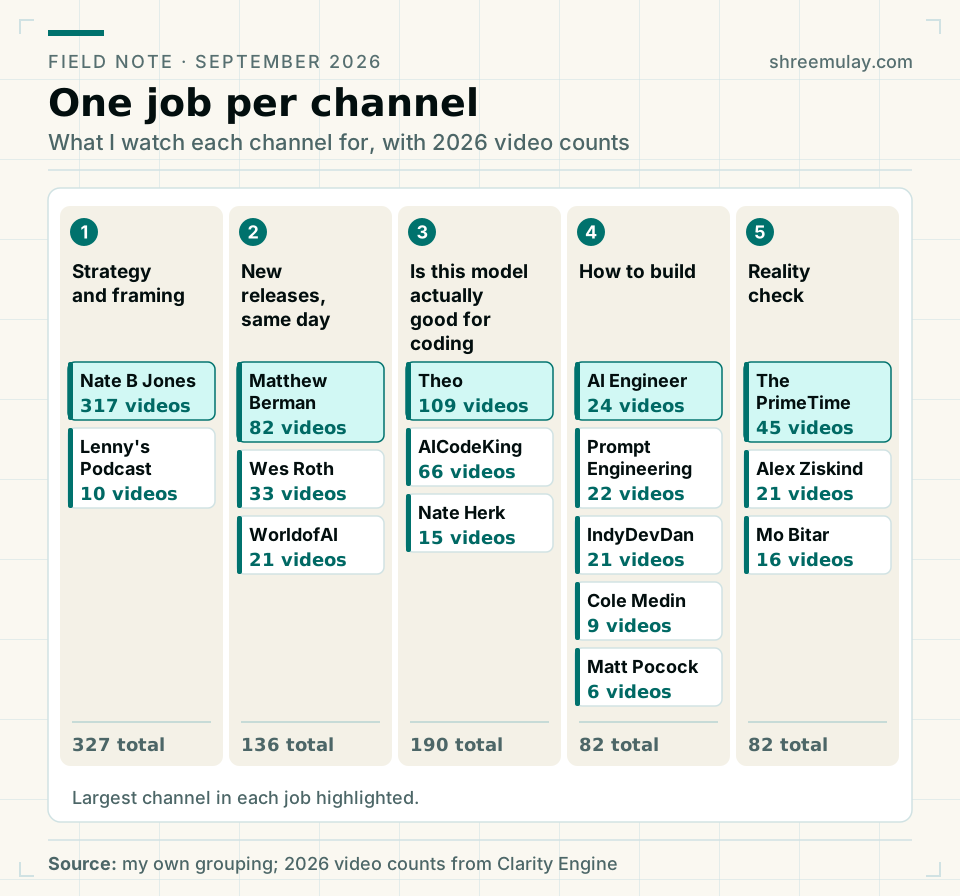
Source: my own grouping of channels by what I use them for, with 2026 video counts from Clarity Engine.
Strategy and framing: Nate B Jones, Lenny’s Podcast.
New releases, same day: Matthew Berman, Wes Roth, WorldofAI.
Is this model actually good for coding: Theo, AICodeKing, Nate Herk.
How to build: IndyDevDan, Prompt Engineering, AI Engineer, Cole Medin, Matt Pocock.
Reality check: The PrimeTime, Mo Bitar, Alex Ziskind.
The biggest change this year is that I read far more than I watch. Clarity Engine gives me the concepts and the thesis in a couple of minutes. If the summary shows me a real test or a new idea, I open the video. If it is a reaction to a benchmark chart, I move on.
Which AI YouTube channels are the most sensational?
By title, a few are much louder than others, and that alone does not tell you whether to watch them. The Reddit thread that ranks for this topic asks for channels that are not sensational content farms. Fair ask. So I measured title style.
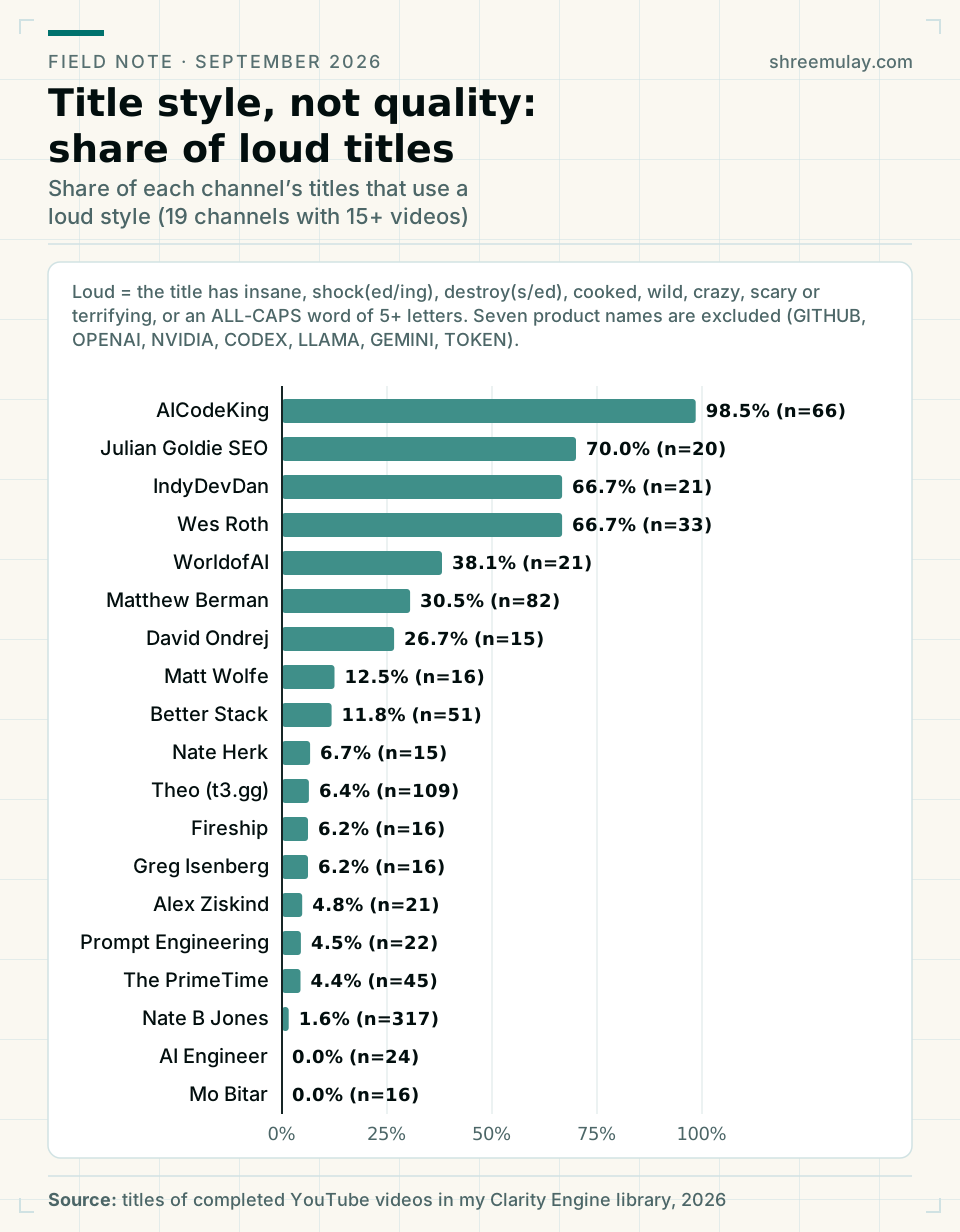
Source: titles of videos I processed in 2026, channels with 15 or more videos. A title counts if it has a hype word (insane, shocked, destroys, cooked, wild, crazy, scary, terrifying) or an all-caps word of five or more letters, excluding product names like OPENAI and NVIDIA. This measures title style, not quality.
AICodeKing tops the chart at 98.5%, mostly from all-caps words, and he is also one of the channels whose tests I found most concrete. Nate B Jones sits at 1.6% and The PrimeTime at 4.4%.
That is why I filter by pattern rather than by name:
- A same-day verdict on a model with no real task is noise.
- No source links, no system card, no repo: I read the summary and skip the video.
- “Fully tested” means nothing until I see what it was tested on.
What this does not claim
- This is one person’s viewing data. It ranks what I paid attention to, not what is objectively best.
- A processed video is not an hour watched. Some are Shorts; some I only read as a summary.
- The counts are floors. 73 videos with no channel metadata are excluded.
- The title-style chart measures words in titles. It says nothing about the accuracy of a video.
- Nothing here is sponsored. None of these creators know this list exists.
Try this yourself
You do not need Clarity Engine to run this audit.
- Download your YouTube watch history from Google Takeout.
- Count videos per channel for the last six months.
- Mark each of your top ten with one job: strategy, news, testing, building, or reality check.
- Look for two channels doing the same job. Keep the one whose videos you actually finish.
What would your top ten look like if you counted?
Did watching change what I use?
Yes, and I measured it. I lined up this library against eleven months of my own AI coding sessions to see which videos changed which models I use, and which did not. Some did within days. Some had nothing to do with it.
For what the videos actually changed, see What my own usage says about the best AI model for coding.